

How Bond ETFs Respond When Interest Rates Rise or Fall
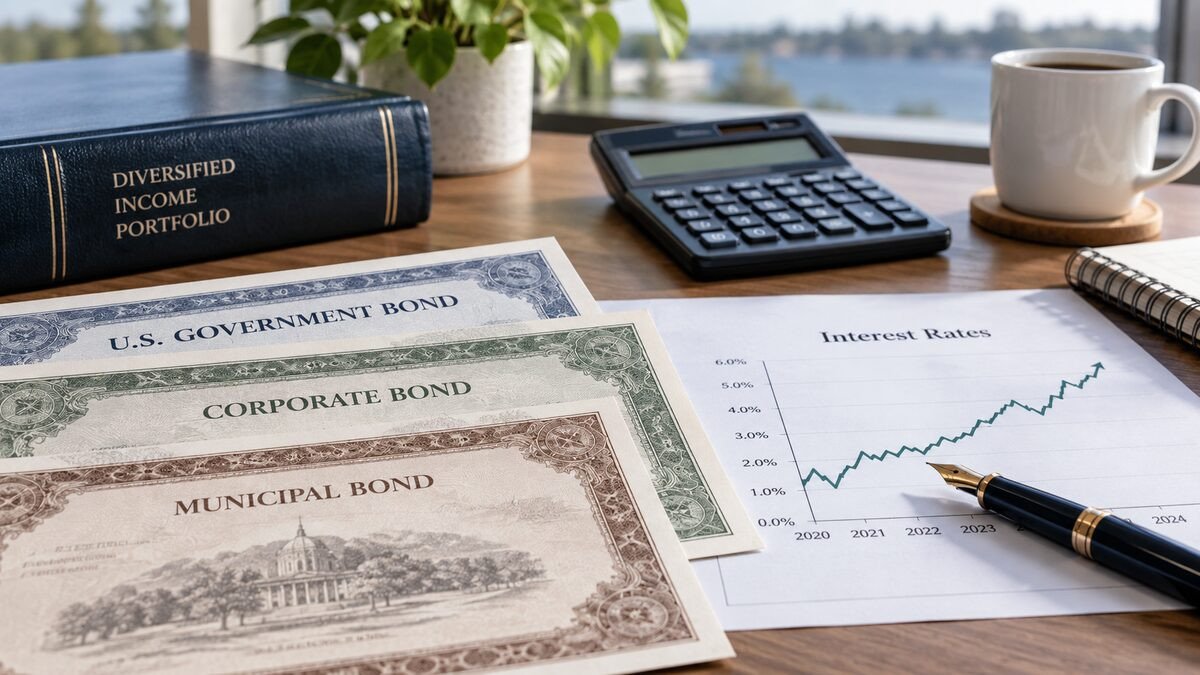
Bond exchange-traded funds can look deceptively simple: investors buy shares, collect distributions, and expect bonds to provide stability. Yet bond ETF prices can move meaningfully when interest rates change. The direction is usually straightforward—existing bond prices tend to fall when market rates rise and rise when market rates fall—but the size and persistence of the move depend on duration, credit quality, maturity, and the fund’s portfolio.
Investor.gov identifies interest-rate risk as a core risk for nearly all bond funds and notes that longer-maturity holdings are generally more sensitive. Understanding that relationship helps investors evaluate a bond ETF without assuming that “bonds are safe” or that a rate cut automatically guarantees a profit.
Why bond prices and rates move in opposite directions
Suppose a fund owns bonds paying 4% and newly issued comparable bonds begin paying 5%. The older bonds become less attractive, so their market value generally falls until their effective yield becomes competitive. When market rates decline, the reverse can happen because existing higher-coupon bonds become more valuable.
A bond ETF reflects the market value of hundreds or thousands of holdings. Its share price can therefore decline even while the fund continues paying income. The distribution yield may gradually adjust as bonds mature, are sold, or are replaced.
Duration is the sensitivity gauge
Duration estimates how much a bond or bond fund’s price may change when interest rates move. A simplified rule of thumb is that a fund with a duration of six years might move roughly 6% in the opposite direction of a one-percentage-point rate change. The estimate is not a promise, but it is useful for comparing funds.
Short-duration funds usually react less to rate changes than long-duration funds. Investors who may need the money soon should be especially careful about taking long-duration risk merely to obtain a higher stated yield.
Yield does not tell the whole story
A higher yield can compensate investors for taking more interest-rate, credit, liquidity, or call risk. It is not free income. High-yield corporate bond funds, for example, generally carry greater default risk than investment-grade government or corporate bond funds.
Compare the SEC yield, average maturity, duration, credit-quality breakdown, expense ratio, and holdings. Two funds labeled “bond ETF” can behave very differently during inflation shocks, recessions, or credit-market stress.
What happens when rates rise
A rate increase usually pressures existing bond prices, particularly long-term bonds. At the same time, the fund can reinvest maturing principal and new investor cash at higher yields. For a long-term holder, that reinvestment can gradually improve income even though the initial price decline is uncomfortable.
The investor’s time horizon matters. Someone selling immediately after a sharp rate increase may realize a loss, while someone holding through the fund’s duration may benefit from the higher income environment—assuming credit conditions remain sound.
What happens when rates fall
Falling rates can lift existing bond prices, especially in longer-duration funds. But distributions may eventually decline as higher-yielding holdings mature and are replaced with lower-yielding bonds. Price appreciation and future income can therefore move in different directions.
Rate cuts can also arrive during an economic slowdown, when corporate credit risk may rise. A government-bond ETF and a lower-quality corporate-bond ETF may not respond the same way.
How to choose a bond ETF for a goal
Start with the job the bonds need to perform: near-term spending, portfolio stability, income, inflation protection, or diversification from stocks. Then match the fund’s duration and credit exposure to that goal.
Review the prospectus and fund fact sheet rather than choosing solely by recent returns. A diversified bond allocation may include different maturities and issuers, but diversification cannot eliminate loss risk.
The bottom line
Bond ETFs are not savings accounts, and their prices are not fixed. Rate changes affect them through duration and market pricing, while credit quality and fees add separate risks. Choose the fund for a defined purpose and time horizon—not because a headline predicts the next central-bank move.
This article is for general educational purposes and is not individualized financial, tax, or investment advice.
Frequently Asked Questions
What's Your Reaction?
 Like
0
Like
0
 Dislike
0
Dislike
0
 Love
0
Love
0
 Funny
0
Funny
0
 Wow
0
Wow
0
 Sad
0
Sad
0
 Angry
0
Angry
0

Finance Mastering delivers practical insights on personal finance, budgeting, investing, and money management. Whether you're just starting out or looking to grow your wealth, we make financial freedom achievable.














Comments (0)